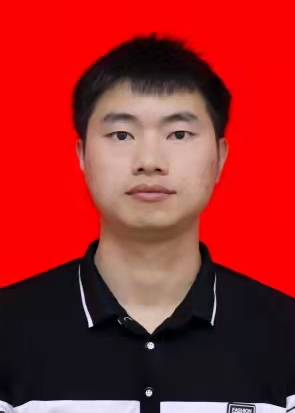
 PhD student @ Northeastern University
I am a thrid-year Ph.D. student in Computer Science at Northeastern University (China), supervised by Prof. Yanfeng Zhang, and a member of iDC-NEU.
I am interested in dynamic graph processing and storage systems and vector databases.
Warning
Problem: The current name of your GitHub Pages repository ("Solution: Please consider renaming the repository to "
http://".
However, if the current repository name is intended, you can ignore this message by removing "{% include widgets/debug_repo_name.html %}" in index.html.
Action required
Problem: The current root path of this site is "baseurl ("_config.yml.
Solution: Please set the
baseurl in _config.yml to "Selected Publications (view all )
LSMGraph: A High-Performance Dynamic Graph Storage System with Multi-level CSR
Song Yu, Shufeng Gong, Qian Tao, Sijie Shen, Wenyuan Yu, Pengxi Liu, Zhixin Zhang, Hongfu Li, Xiaojian Luo, Ge Yu, Jingren Zhou
Proceedings of the International Conference on Management of Data (SIGMOD) 2025
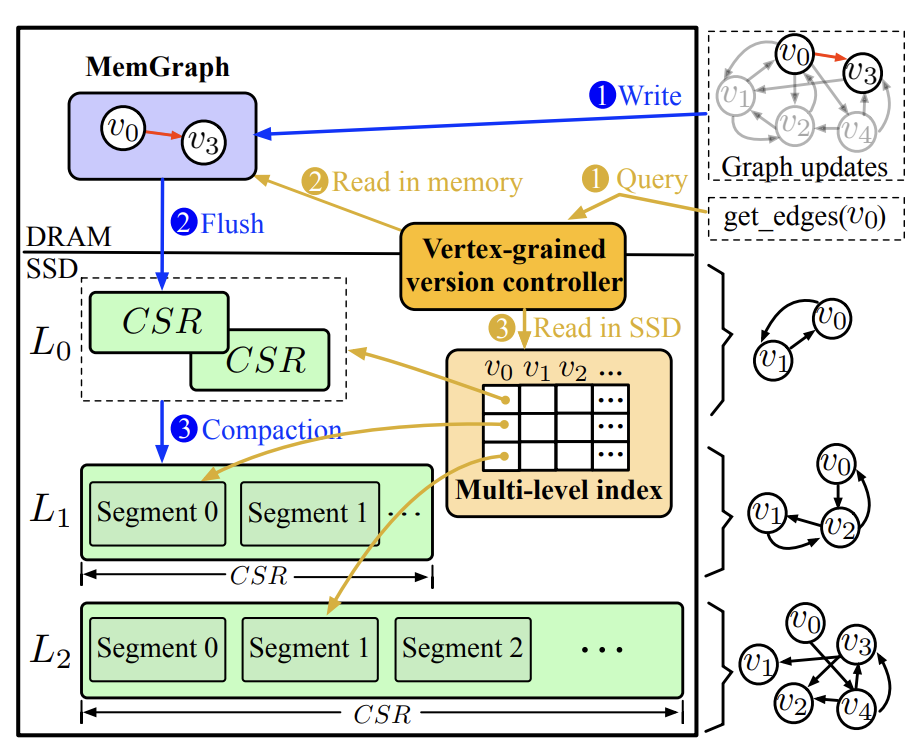
We propose LSMGraph, a novel dynamic graph storage system that combines the write-friendly LSM-tree and the read-friendly CSR. It leverages the multi-level structure of LSM-trees to optimize write performance while utilizing the compact CSR structures embedded in the LSM-trees to boost read performance. LSMGraph uses a new memory structure, MemGraph, to efficiently cache graph updates and uses a multi-level index to speed up reads within the multi-level structure. Furthermore, LSMGraph incorporates a vertex-grained version control mechanism to mitigate the impact of LSM-tree compaction on read performance and ensure the correctness of concurrent read and write operations.
LSMGraph: A High-Performance Dynamic Graph Storage System with Multi-level CSR
Song Yu, Shufeng Gong, Qian Tao, Sijie Shen, Wenyuan Yu, Pengxi Liu, Zhixin Zhang, Hongfu Li, Xiaojian Luo, Ge Yu, Jingren Zhou
Proceedings of the International Conference on Management of Data (SIGMOD) 2025
We propose LSMGraph, a novel dynamic graph storage system that combines the write-friendly LSM-tree and the read-friendly CSR. It leverages the multi-level structure of LSM-trees to optimize write performance while utilizing the compact CSR structures embedded in the LSM-trees to boost read performance. LSMGraph uses a new memory structure, MemGraph, to efficiently cache graph updates and uses a multi-level index to speed up reads within the multi-level structure. Furthermore, LSMGraph incorporates a vertex-grained version control mechanism to mitigate the impact of LSM-tree compaction on read performance and ensure the correctness of concurrent read and write operations.
A Topology-Aware Localized Update Strategy for Graph-Based ANN Index
Song Yu, Shengyuan Lin, Shufeng Gong, Yongqing Xie, Ruicheng Liu, Yijie Zhou, Ji Sun, Yanfeng Zhang, Guoliang Li, Ge Yu
Very Large Data Bases (VLDB) 2026
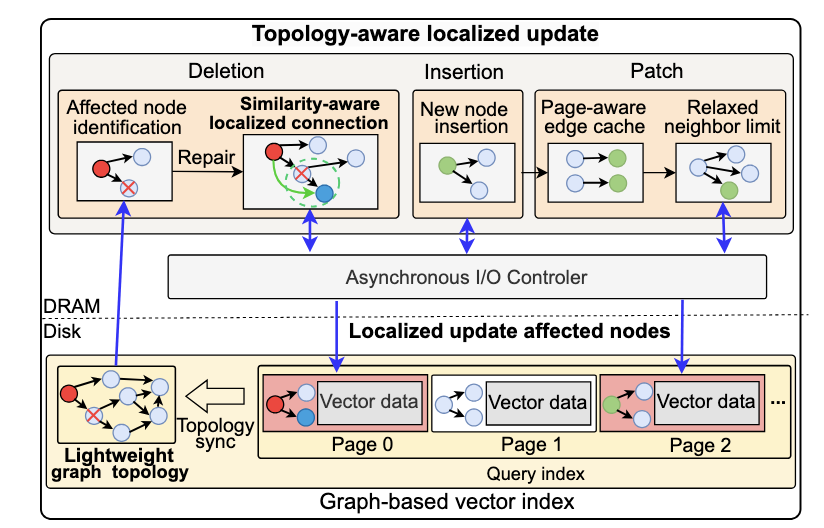
We propose a topology-aware localized update strategy that exploits the locality of small-batch updates to reduce unnecessary I/O and computation. Specifically, we introduce a lightweight graph topology to efficiently identify affected nodes without full index scans and adopt a localized update mechanism that confines index modifications to only the affected file pages, thereby greatly reducing unnecessary I/O overhead. Moreover, we design a similarity-aware local connection method that links each affected node to a small set of the most similar neighbors in the deleted node’s local region, reducing redundant connections and avoiding expensive pruning.
A Topology-Aware Localized Update Strategy for Graph-Based ANN Index
Song Yu, Shengyuan Lin, Shufeng Gong, Yongqing Xie, Ruicheng Liu, Yijie Zhou, Ji Sun, Yanfeng Zhang, Guoliang Li, Ge Yu
Very Large Data Bases (VLDB) 2026
We propose a topology-aware localized update strategy that exploits the locality of small-batch updates to reduce unnecessary I/O and computation. Specifically, we introduce a lightweight graph topology to efficiently identify affected nodes without full index scans and adopt a localized update mechanism that confines index modifications to only the affected file pages, thereby greatly reducing unnecessary I/O overhead. Moreover, we design a similarity-aware local connection method that links each affected node to a small set of the most similar neighbors in the deleted node’s local region, reducing redundant connections and avoiding expensive pruning.
GoVector:基于向量相似性的I/O高效向量近邻查询缓存策略 (GoVector: An I/O-Efficient Caching Strategy for High-Dimensional Vector Neighbor Search)
周依杰, 林圣原, 巩树凤, 余松, 范书豪, 张岩峰, 于戈
软件学报, 2025, 37(3): 0-0. 2025
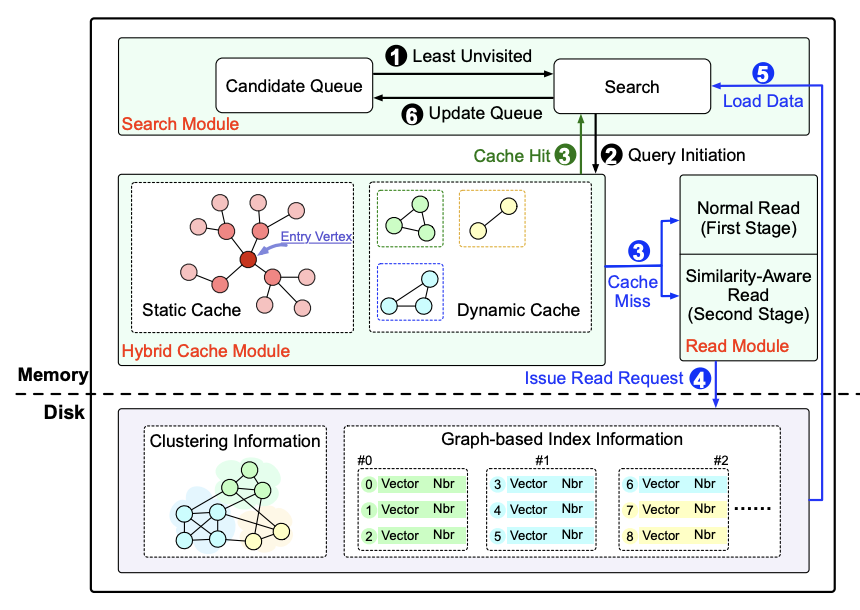
We propose GoVector, an I/O-efficient caching strategy tailored for disk-based graph indices. GoVector combines (1) a static cache that stores entry points and frequently accessed neighbors, and (2) a dynamic cache that adaptively captures nodes with high spatial locality during the second search phase. To further align storage layout with similarity-driven search patterns, GoVector reorders nodes on disk so that similar vectors are colocated on the same or adjacent pages, thereby improving locality and reducing I/O overhead. Extensive experiments on multiple public datasets show that GoVector achieves substantial performance improvements.
GoVector:基于向量相似性的I/O高效向量近邻查询缓存策略 (GoVector: An I/O-Efficient Caching Strategy for High-Dimensional Vector Neighbor Search)
周依杰, 林圣原, 巩树凤, 余松, 范书豪, 张岩峰, 于戈
软件学报, 2025, 37(3): 0-0. 2025
We propose GoVector, an I/O-efficient caching strategy tailored for disk-based graph indices. GoVector combines (1) a static cache that stores entry points and frequently accessed neighbors, and (2) a dynamic cache that adaptively captures nodes with high spatial locality during the second search phase. To further align storage layout with similarity-driven search patterns, GoVector reorders nodes on disk so that similar vectors are colocated on the same or adjacent pages, thereby improving locality and reducing I/O overhead. Extensive experiments on multiple public datasets show that GoVector achieves substantial performance improvements.
Accelerating Graph Processing through Incremental Reordering
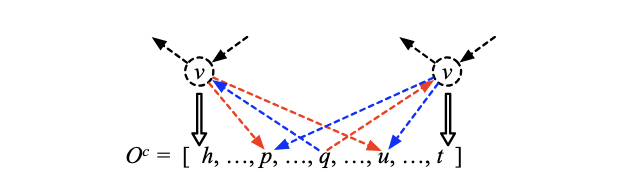
Yijie Zhou, Shufeng Gong, Feng Yao, Hanzhang Chen, Song Yu, Pengxi Liu, Yanfeng Zhang, Ge Yu, Jeffrey Xu Yu
Transactions on Knowledge and Data Engineering (TKDE) 2025
We propose a metric function to evaluate the effectiveness of vertex processing order in accelerating iterative computations. Leveraging this metric, we propose a novel graph reordering method, GoGraph, which constructs an efficient vertex processing order. Additionally, for evolving graphs, GoGraph implements incremental adjustments to vertex order during batch updates of edges. we further propose a metric function designed to evaluate the effectiveness of vertex processing orders in response to graph changes and provide three optional methods for dynamically adjusting the vertex processing order.
Accelerating Graph Processing through Incremental Reordering
Yijie Zhou, Shufeng Gong, Feng Yao, Hanzhang Chen, Song Yu, Pengxi Liu, Yanfeng Zhang, Ge Yu, Jeffrey Xu Yu
Transactions on Knowledge and Data Engineering (TKDE) 2025
We propose a metric function to evaluate the effectiveness of vertex processing order in accelerating iterative computations. Leveraging this metric, we propose a novel graph reordering method, GoGraph, which constructs an efficient vertex processing order. Additionally, for evolving graphs, GoGraph implements incremental adjustments to vertex order during batch updates of edges. we further propose a metric function designed to evaluate the effectiveness of vertex processing orders in response to graph changes and provide three optional methods for dynamically adjusting the vertex processing order.
GastCoCo: Graph Storage and Coroutine-Based Prefetch Co-Design for Dynamic Graph
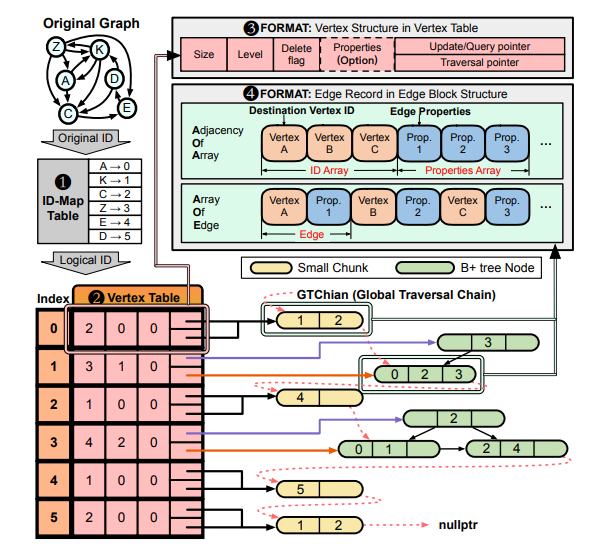
Hongfu Li, Qian Tao, Song Yu, Qiange Wang, Shufeng Gong, Yanfeng Zhang, Feng Yao, Wenyuan Yu, Ge Yu, Jingren Zhou
Very Large Data Bases (VLDB) 2025
We present GastCoCo, a system with graph storage and coroutine-based prefetch co-design. By employing software prefetching via stackless coroutines and designing a prefetch-friendly data structure CBList, GastCoCo significantly alleviates the performance degradation caused by cache misses.
GastCoCo: Graph Storage and Coroutine-Based Prefetch Co-Design for Dynamic Graph
Hongfu Li, Qian Tao, Song Yu, Qiange Wang, Shufeng Gong, Yanfeng Zhang, Feng Yao, Wenyuan Yu, Ge Yu, Jingren Zhou
Very Large Data Bases (VLDB) 2025
We present GastCoCo, a system with graph storage and coroutine-based prefetch co-design. By employing software prefetching via stackless coroutines and designing a prefetch-friendly data structure CBList, GastCoCo significantly alleviates the performance degradation caused by cache misses.
Fast Iterative Graph Computing with Updated Neighbor States
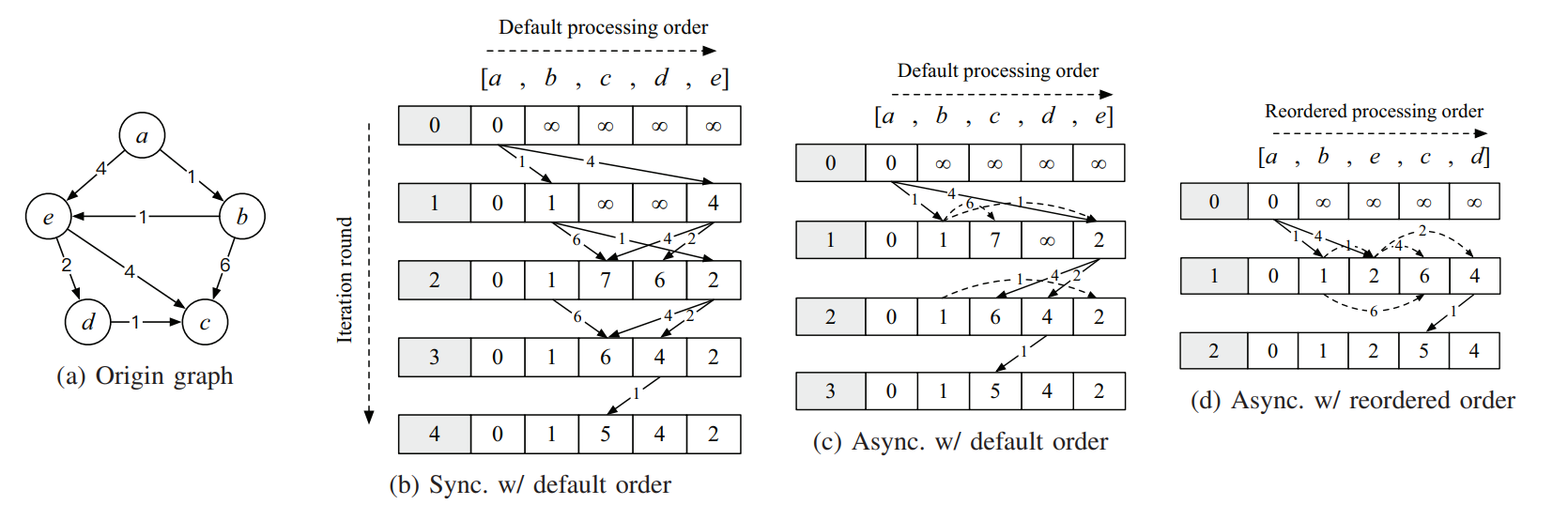
Yijie Zhou, Shufeng Gong, Feng Yao, Hanzhang Chen, Song Yu, Pengxi Liu, Yanfeng Zhang, Ge Yu, Jeffrey Xu Yu
International Conference on Data Engineering (ICDE) 2024
We propose a graph reordering method, GoGraph, which can construct a well-formed vertex processing order effectively reducing the number of iteration rounds and, consequently, accelerating iterative computation. Before delving into GoGraph, a metric function is introduced to quantify the efficiency of vertex processing order in accelerating iterative computation. This metric reflects the quality of the processing order by counting the number of edges whose source precedes the destination. GoGraph employs a divide-and-conquer mindset to establish the vertex processing order by maximizing the value of the metric function.
Fast Iterative Graph Computing with Updated Neighbor States
Yijie Zhou, Shufeng Gong, Feng Yao, Hanzhang Chen, Song Yu, Pengxi Liu, Yanfeng Zhang, Ge Yu, Jeffrey Xu Yu
International Conference on Data Engineering (ICDE) 2024
We propose a graph reordering method, GoGraph, which can construct a well-formed vertex processing order effectively reducing the number of iteration rounds and, consequently, accelerating iterative computation. Before delving into GoGraph, a metric function is introduced to quantify the efficiency of vertex processing order in accelerating iterative computation. This metric reflects the quality of the processing order by counting the number of edges whose source precedes the destination. GoGraph employs a divide-and-conquer mindset to establish the vertex processing order by maximizing the value of the metric function.
Ingress: an automated incremental graph processing system
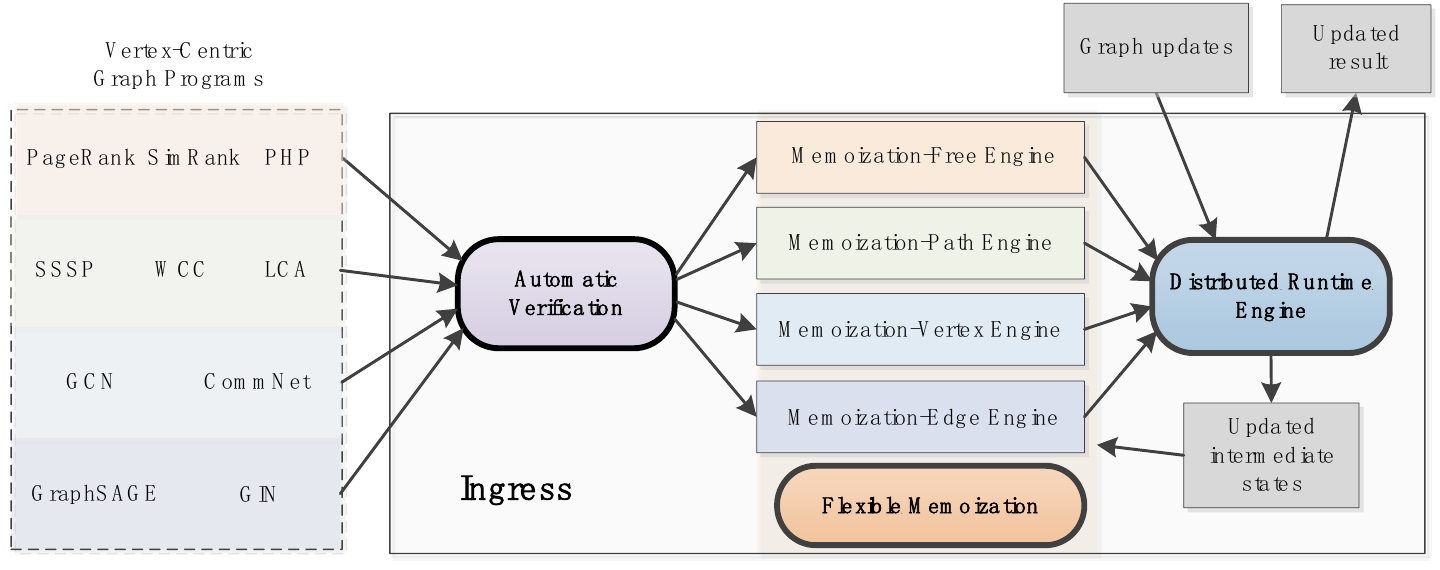
Shufeng Gong, Chao Tian, Qiang Yin, Zhengdong Wang, Song Yu, Yanfeng Zhang, Wenyuan Yu, Liang Geng, Chong Fu, Ge Yu, Jingren Zhou
VLDB J 2024
We propose Ingress, an automated system for incremental graph processing. Ingressis able to deduce the incremental counterpart of a batch vertex-centric algorithm, without the need of redesigned logic or data structures from users. Underlying Ingressis an automated incrementalization framework equipped with four different memoization policies, to support all kinds of vertexcentric computations with optimized memory utilization. We identify sufficient conditions for the applicability of these policies. Ingress chooses the best-fit policy for a given algorithm automatically by verifying these conditions. In addition to the ease-of-use and generalization, Ingress outperforms state-of-the-art incremental graph systems by 12.14× on average (up to 49.23×) in efficiency
Ingress: an automated incremental graph processing system
Shufeng Gong, Chao Tian, Qiang Yin, Zhengdong Wang, Song Yu, Yanfeng Zhang, Wenyuan Yu, Liang Geng, Chong Fu, Ge Yu, Jingren Zhou
VLDB J 2024
We propose Ingress, an automated system for incremental graph processing. Ingressis able to deduce the incremental counterpart of a batch vertex-centric algorithm, without the need of redesigned logic or data structures from users. Underlying Ingressis an automated incrementalization framework equipped with four different memoization policies, to support all kinds of vertexcentric computations with optimized memory utilization. We identify sufficient conditions for the applicability of these policies. Ingress chooses the best-fit policy for a given algorithm automatically by verifying these conditions. In addition to the ease-of-use and generalization, Ingress outperforms state-of-the-art incremental graph systems by 12.14× on average (up to 49.23×) in efficiency
Layph: Making Change Propagation Constraint in Incremental Graph Processing by Layering Graph
Song Yu, Shufeng Gong, Yanfeng Zhang, Wenyuan Yu, Qiang Yin, Chao Tian, Qian Tao, Yongze Yan, Ge Yu, Jingren Zhou
International Conference on Data Engineering (ICDE) 2023
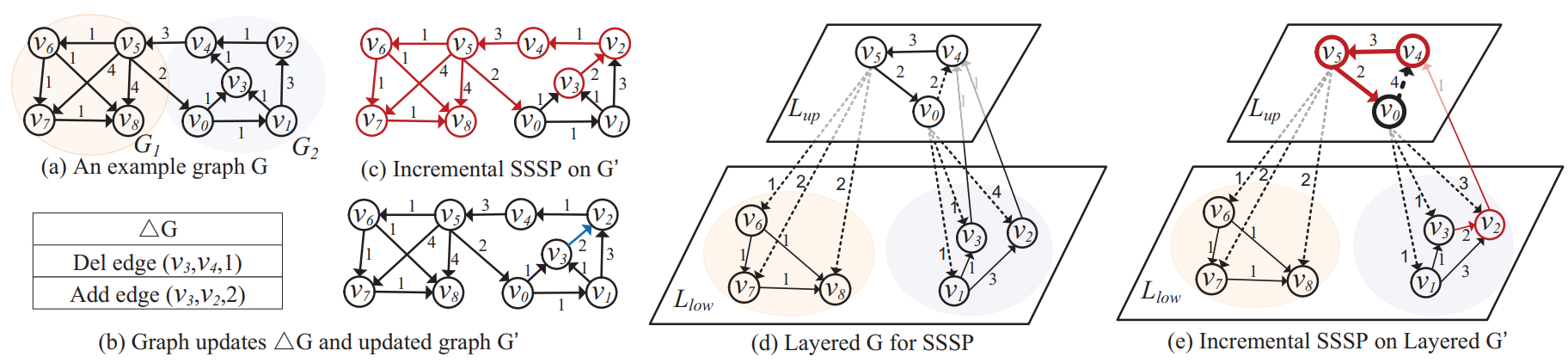
We propose Layph, a two-layered graph framework. The upper layer is a skeleton of the graph which is much smaller than the original graph, and the lower layer has some disjoint subgraphs. Layph limits costly global iterative computations on the original graph to the small graph skeleton and a few subgraphs updated with the input graph changes. In this way, many vertices and edges are not involved in iterative computations, which significantly reduces the computation overhead and improves the performance of incremental graph processing.
Layph: Making Change Propagation Constraint in Incremental Graph Processing by Layering Graph
Song Yu, Shufeng Gong, Yanfeng Zhang, Wenyuan Yu, Qiang Yin, Chao Tian, Qian Tao, Yongze Yan, Ge Yu, Jingren Zhou
International Conference on Data Engineering (ICDE) 2023
We propose Layph, a two-layered graph framework. The upper layer is a skeleton of the graph which is much smaller than the original graph, and the lower layer has some disjoint subgraphs. Layph limits costly global iterative computations on the original graph to the small graph skeleton and a few subgraphs updated with the input graph changes. In this way, many vertices and edges are not involved in iterative computations, which significantly reduces the computation overhead and improves the performance of incremental graph processing.
Automating Incremental Graph Processing with Flexible Memoization
Shufeng Gong, Chao Tian, Qiang Yin, Wenyuan Yu, Yanfeng Zhang, Liang Geng, Song Yu, Ge Yu, Jingren Zhou
Very Large Data Bases (VLDB) 2021
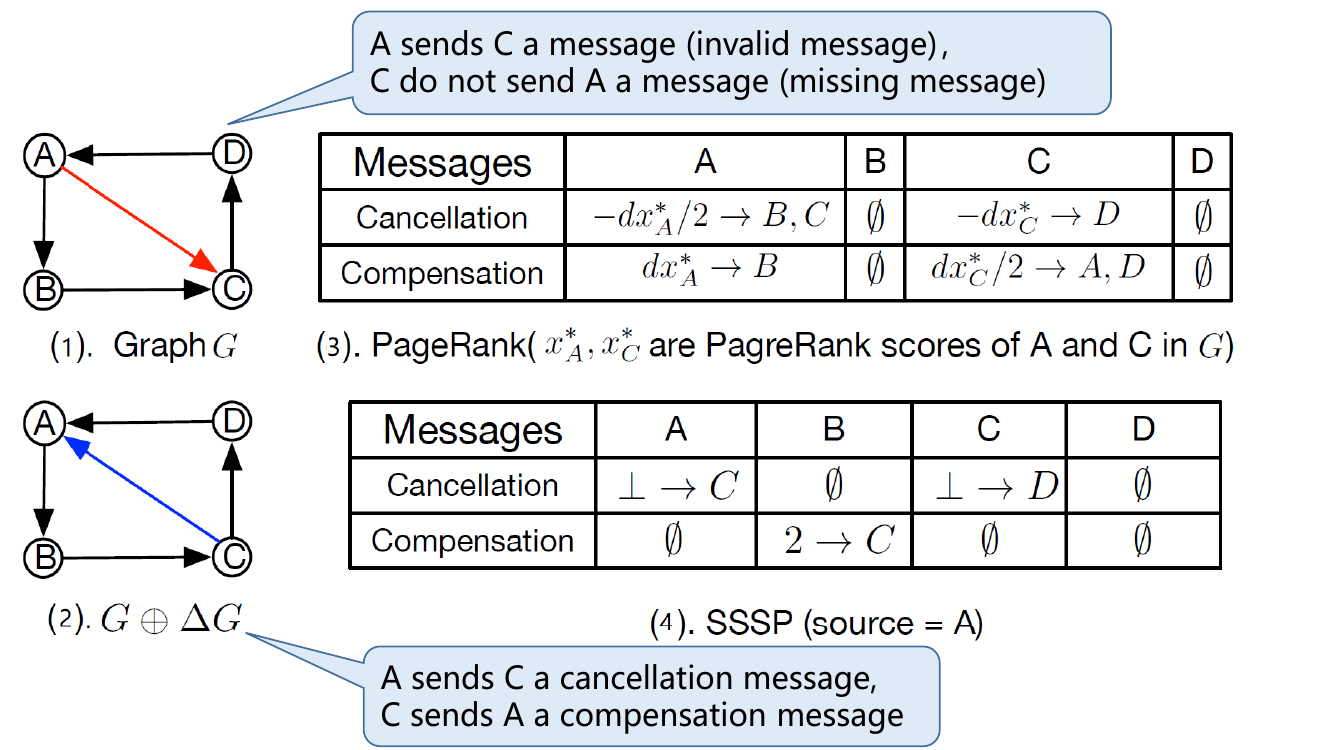
We propose Ingress, an automated system for incremental graph processing. Ingress is able to incrementalize batch vertex-centric algorithms into their incremental counterparts as a whole, without the need of redesigned logic or data structures from users. Underlying Ingress is an automated incrementalization framework equipped with four different memoization policies, to support all kinds of vertex-centric computations with optimized memory utilization. We identify sufficient conditions for the applicability of these policies. Ingress chooses the best-fit policy for a given algorithm automatically by verifying these conditions.
Automating Incremental Graph Processing with Flexible Memoization
Shufeng Gong, Chao Tian, Qiang Yin, Wenyuan Yu, Yanfeng Zhang, Liang Geng, Song Yu, Ge Yu, Jingren Zhou
Very Large Data Bases (VLDB) 2021
We propose Ingress, an automated system for incremental graph processing. Ingress is able to incrementalize batch vertex-centric algorithms into their incremental counterparts as a whole, without the need of redesigned logic or data structures from users. Underlying Ingress is an automated incrementalization framework equipped with four different memoization policies, to support all kinds of vertex-centric computations with optimized memory utilization. We identify sufficient conditions for the applicability of these policies. Ingress chooses the best-fit policy for a given algorithm automatically by verifying these conditions.